You are shopping online and the listing says “8 inches.” The number looks clear, but your mind draws a blank. Is that big? Small? Will it fit in your drawer or your hand?
That gap between a number and a mental picture is why measurements go wrong. A familiar object fixes it instantly, because you already know how it looks and feels.
In this guide, you will find 15 everyday things that match this length. Each one is labeled as Exact (made to a fixed standard) or Approx (close, but it varies), with a practical tip so you can use the reference with confidence.
What Does 8 Inches Look Like?
Picture a ruler. Now cut off the last third. What remains is 8 inches.
It is longer than a pen and a smartphone, but shorter than a sheet of paper. It is a mid-range length: not tiny, not large, which is why it is easy to misjudge.
How Long Is 8 Inches?
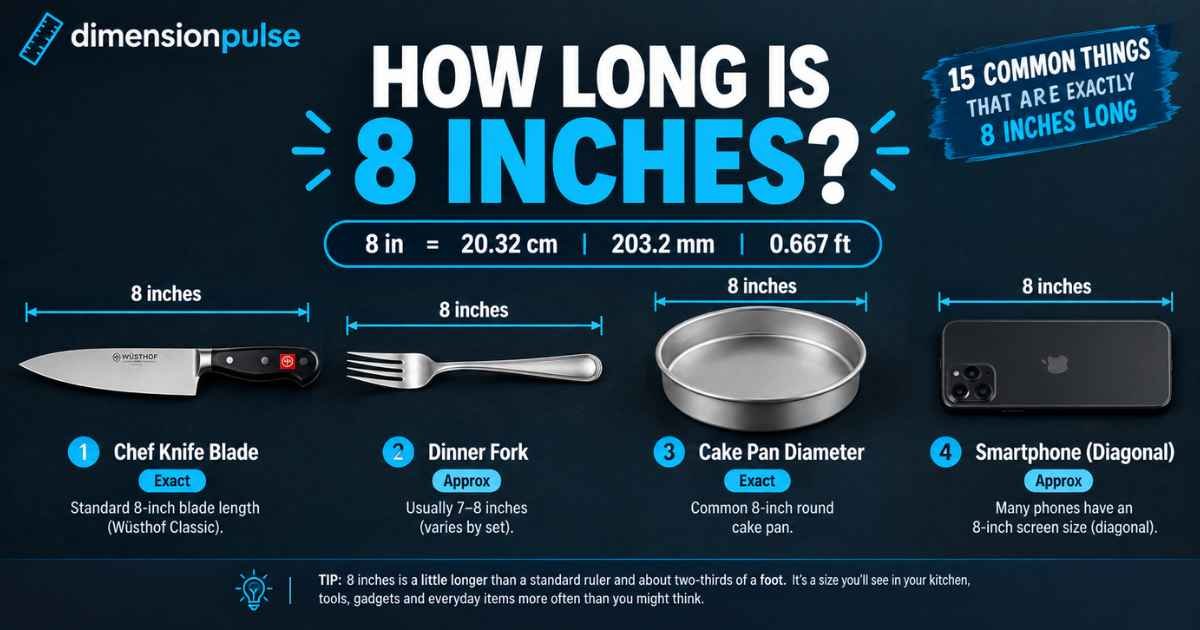
Quick answer: 8 inches equals 20.32 centimeters, 203.2 millimeters, or about 0.667 feet.
In everyday terms, it is about the length of a standard chef knife blade or a medium kitchen pan.
What Does 8 Inches Long Actually Mean?
One inch is defined as exactly 2.54 centimeters. Multiply that by 8 and you get 20.32 cm.
A foot has 12 inches, so 8 inches is two-thirds of a foot. That puts it past the halfway mark but clearly short of a full foot.
If you are using a metric ruler, look for the 20 cm line and add just 3 millimeters. That is your 8-inch mark.
Why 8 Inches Shows Up So Often
Start looking around your home, and you will spot 8 inches in more places than you expect.
There is a good reason for that. This length sits comfortably in the hand. It is not so short that a tool feels fiddly, and not so long that it gets awkward to hold.
In tools and kitchen items, that matters a lot. An 8-inch handle or blade gives you enough reach to work with control, whether you are slicing vegetables or turning a nut.
At the same time, it stays compact. It fits in a drawer, a toolbox, or a bag without taking much room.
That mix of usefulness and portability is why makers return to this size again and again. You meet it in the things you use every day, often without noticing.
It also explains why a picture in your head helps. Once you know what 8 inches looks like, you can read a product listing with confidence and avoid ordering something that turns out too big or too small.
Quick Conversion Table (8 Inches in Different Units)
| Unit | Equivalent |
| Inches | 8 in |
| Centimeters | 20.32 cm |
| Millimeters | 203.2 mm |
| Feet | 0.667 ft |
| Yards | 0.222 yd |
| Meters | 0.2032 m |
15 Common Things That Are About 8 Inches Long
The items below are real, familiar objects. Some are made to an exact 8-inch standard. Others are close enough to work as a quick visual guide. Each label tells you which is which.
1. Wüsthof Classic Chef Knife Blade
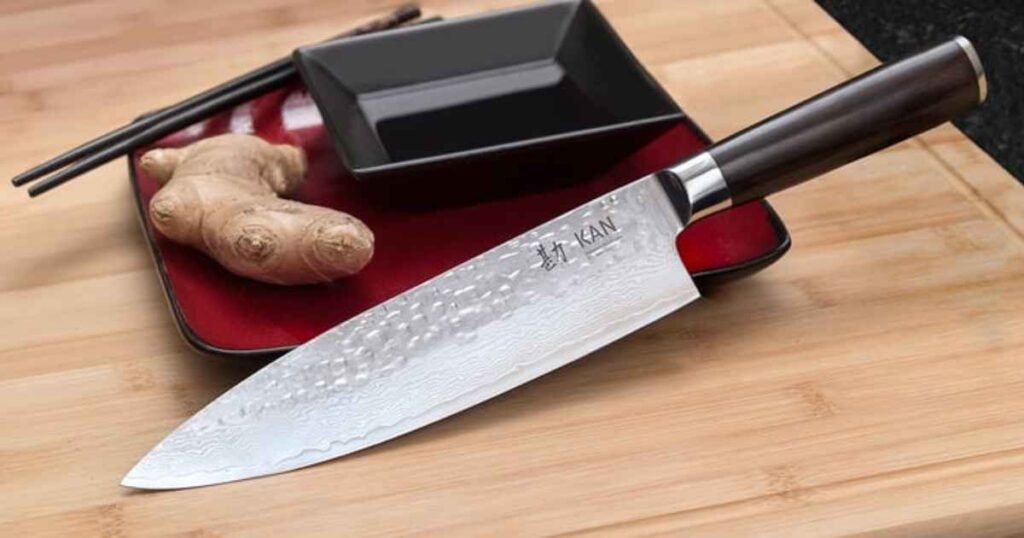
Wüsthof’s Classic chef knife is sold with a standard 8-inch blade, and it is one of the best-known knives in professional kitchens and in home drawers alike.
The 8 inches is the length of the steel itself, running from the tip of the blade to the point where it meets the handle. Lay it flat on a cutting board and you will notice the blade reaches far beyond the width of your palm.
That extra reach is what lets a cook slice through a large cabbage, a watermelon, or a whole onion in one smooth pass without sawing back and forth.
Because the blade length is fixed by the maker, you can trust it as a dependable reference every time.
If you want to see 8 inches in real life, this knife is one of the quickest ways to do it.
Practical Tip: Knife size usually refers to the blade only, not the handle. The full knife will be longer, so check the total length if you are buying a knife block, a drawer organizer, or a storage case.
2. Small Dinner Fork
A standard dinner fork usually measures somewhere between 7 and 8 inches from the end of the handle to the tips of the tines.
It is a plain, everyday object, and that is exactly why it works so well as a measuring aid.
You probably have one within arm’s reach right now.
There is nothing to buy or look for: take a fork from the drawer, set it on the table, and you can picture the length straight away.
It is also easy to compare.
Hold it next to a phone, a notebook, or a plate and you can see at once how much longer 8 inches is than the small things you handle all day.
Practical Tip: Forks vary from one cutlery set to another. Before you use yours as a guide, measure it once against a ruler and remember the result, and your fork becomes a personal 8-inch gauge.
3. 8-Inch Cake Pan Diameter
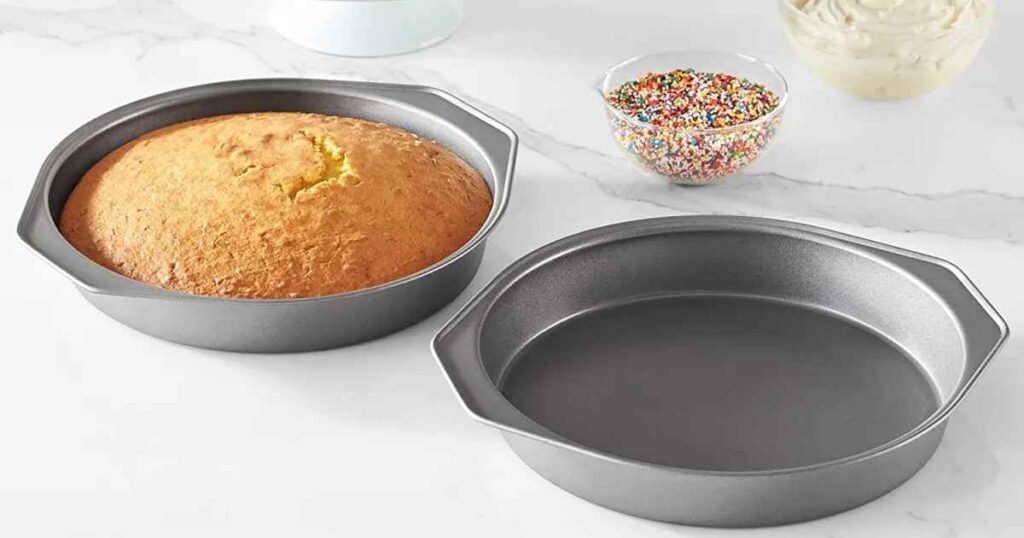
Cake pans are made in fixed sizes, and 8 inches is one of the most common ones in baking.
You will find it in bakeries, in home kitchens, and in almost every set of round pans.
Look at the pan from above.
The distance from one inner edge to the opposite inner edge is your 8 inches.
It is wide enough for a medium cake that serves a small group, yet small enough to handle easily with one hand.
Place it on a countertop and you will also notice how much surface it covers.
That gives you a feel for the space this length takes up, which is useful when you are arranging a table or planning where a dish will sit.
Practical Tip: Always measure the pan from the inside edge, not the outer rim. If a recipe asks for a 9-inch pan and you only have an 8-inch one, expect a taller cake and a slightly longer baking time, so check it a few minutes later than the recipe says.
4. Medium Banana
A medium banana typically runs 7 to 8 inches along its curve, which makes it a very handy, very familiar reference.
Almost everyone has held one, so the size is already stored in your memory.
Its curved shape is instantly recognizable, and because bananas are such a common snack, the length feels natural and easy to remember.
You do not need any tools, just a fruit basket or a kitchen counter.
It also adds a fun touch when you are explaining a size to a child or a friend.
Whether you are in the kitchen or out on a picnic, a banana turns an abstract number into something you can see and hold.
Practical Tip: The length is measured along the peel, and bananas come in small, medium, and large sizes. Pick a medium one and measure it once before you rely on it, and do not use an extra-large banana as your reference.
5. Small Tablet or E-Reader
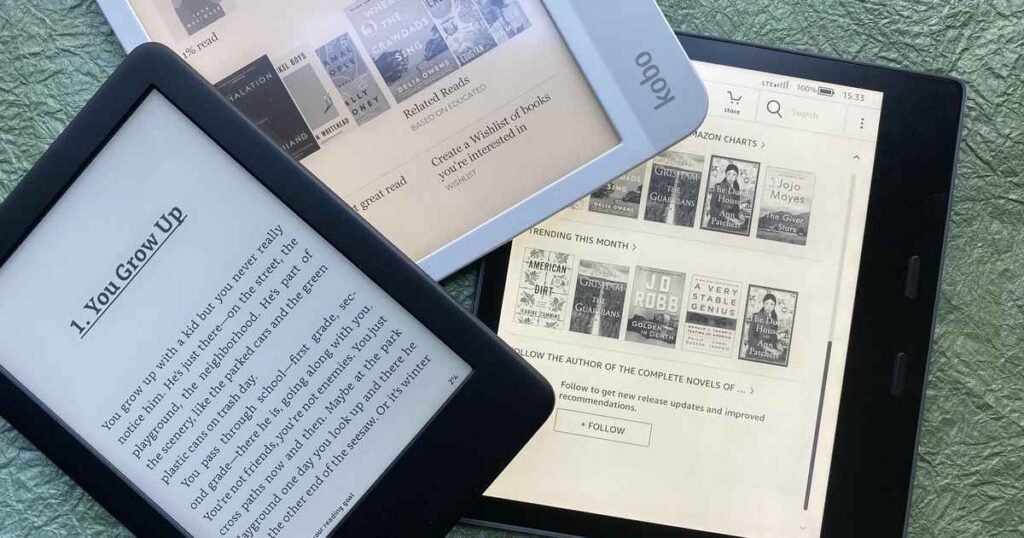
Many compact tablets and e-readers are sold as “8-inch” devices.
They are light, easy to carry in one hand, and made for reading, browsing, and watching videos on the go.
Here is the catch: that number is the screen’s diagonal, measured from one corner of the display to the opposite corner. It is not the length of the device itself, and it is not the length of one side of the screen either.
Think of the screen as the 8-inch part, and the whole device as slightly larger because of the frame around it.
Held in your hand, it feels bigger than a phone but still easy to carry, though it will not fit in a regular pocket.
Practical Tip: When buying, compare the width and height of the device in the specs, not just the screen size. This matters most when you are choosing a case, a stand, or a bag, because the case has to fit the body of the device, not the screen.
6. Eight US Quarters
A US quarter is about 0.955 inches across.
Line up eight of them edge to edge in a straight row and you get roughly 7.6 inches.
That is a little short of a full 8 inches, but close enough to work as a quick visual guide.
The coins are all exactly the same size, so every row you make will give you the same result.
It is a neat trick when you have loose change on a desk and no ruler in sight.
Just remember that the row is slightly under 8 inches, so treat it as a close estimate rather than an exact measurement.
Practical Tip: Add a thumb’s width to the end of the row to reach a true 8 inches. If you do not have US coins, use a standard A4 sheet instead: its shorter side is about 8.27 inches, which is easy to find at home or in the office.
7. Desk Figurines / Sculptures

Small decorative figurines and desk sculptures often stand around 8 inches tall.
They are common in home offices, study corners, and on bookshelves, which means many people already own one.
Their upright shape makes the height easy to judge, and they sit right where you work.
A figurine is usually placed on a flat surface, so you can compare it directly with the objects around it.
Put one beside your monitor, a stack of books, or a row of stationery and you can see how tall 8 inches really is.
It is a decorative piece that quietly doubles as a size guide.
Practical Tip: Decorative items have no fixed standard. Check the product’s listed height before you buy, and never assume it is 8 inches just because it looks about right. Heights can differ by an inch or more between brands.
8. 8-Inch Drywall Knife Blade
Drywall taping knives are made in fixed sizes, and 8 inches is one of the standard blade widths.
You will find them in hardware shops and on construction sites.
They are used to spread joint compound over wall seams and to smooth the surface afterwards.
The blade is flat, thin, and wide, so it covers a good stretch of wall in a single stroke.
Hold one up and you can see 8 inches of steel in front of you, with the handle sitting behind it.
Few hand tools are this wide, so the size stands out right away.
That width is exactly what helps spread the compound in an even, smooth layer.
Practical Tip: Taping knives are sized by blade width, not by the length of the whole tool. The handle adds extra length, so do not expect the full knife to measure 8 inches end to end. Many people use a narrower knife of about 4 to 6 inches for taping seams and a wider one for the final coats, so choose by the job.
9. 8-Inch Adjustable Wrench
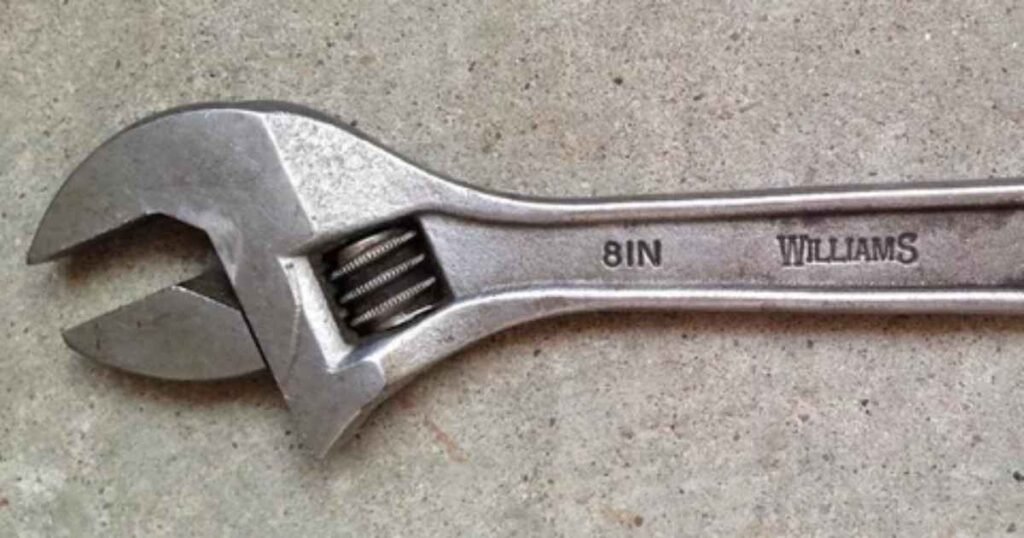
Adjustable wrenches are sold in set lengths, and 8 inches is one of the most common sizes in home toolkits.
That number is the length of the whole tool, from the end of the handle to the tip of the jaw.
A wrench this size is a good all-round choice for repairs around the house, such as plumbing nuts, furniture bolts, and bicycle fittings.
The handle extends comfortably beyond your palm, which gives you a firm grip and enough leverage for everyday jobs.
It is small enough to fit in a drawer or a tool bag, but long enough that you can clearly see 8 inches when you hold it.
Since tool sizes follow a standard, it is a trustworthy visual reference.
Practical Tip: The size on the label is the overall length, not how wide the jaw opens. An 8-inch wrench usually opens to around 1 inch, but check the jaw capacity in the specs to be sure it fits the nuts you work with.
10. 8-Inch Bolt Cutter
Mini bolt cutters are made in a compact 8-inch size, and the number refers to the whole tool.
They are used for cutting thin wire, small chains, and light bolts.
The two handles meet at the cutting head, and those handles are what multiply the force from your hand.
For a tool this short, it is surprisingly strong.
It is small enough to throw into a toolbox or a car boot, yet its length is easy to see when you open the handles.
It gives a clear picture of 8 inches in a tool you may already own.
Practical Tip: Handle length decides how much force you get. An 8-inch cutter is fine for soft wire and thin material, but it will struggle with thick or hardened metal. For heavier jobs, choose a longer cutter instead of forcing a small one, because that can damage the blades.
11. 8-Inch Embroidery Hoop
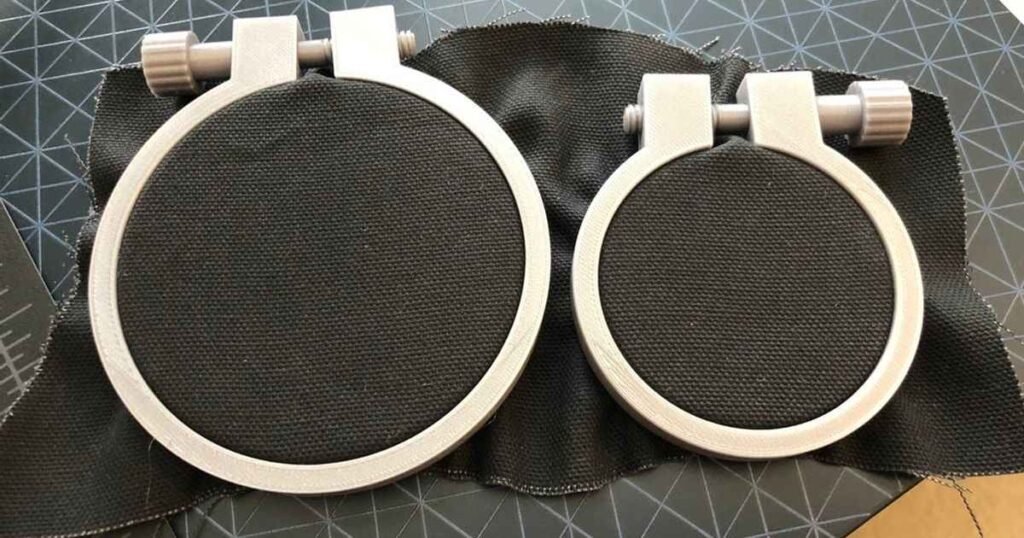
Embroidery hoops are made in set diameters, and 8 inches is a popular size.
A hoop has two rings: an inner ring, and an outer ring with a screw that tightens the fabric.
Looking at it from the front, you see a perfect circle, and the distance from one side to the other is your 8 inches.
That space is large enough for a medium design, such as a flower pattern or a short line of lettering.
It is also light enough to hold in one hand while you stitch.
Many people hang their finished work in the hoop as wall art, so it is a size you may see in homes and craft shops.
Practical Tip: Hoop size is usually measured across the inner ring, so the stitching area is slightly smaller than the outer ring. When you buy fabric, cut it at least 2 inches larger than the hoop on every side so you can hold and tighten it properly.
12. 8-Inch Frying Pan Surface
Frying pans are labeled by diameter, and an 8-inch pan is a standard small size found in kitchens everywhere.
The measurement is taken across the top, from one inner edge of the rim to the other, and it does not include the handle.
It is a good size for cooking for one person, such as an omelet, a fried egg, or a single serving of pancakes.
The flat base is a little smaller than the top, so the cooking surface comes out slightly under 8 inches.
On a stovetop, it sits neatly on one burner without crowding the others.
Place one on a counter and you get an instant picture of 8 inches.
Practical Tip: Brands measure differently. Some measure the top rim and others measure the cooking surface, so two pans labeled 8 inches can be slightly different. Check the listing for both measurements, and remember that the handle adds more length.
13. 8-Inch Picture Frame Opening
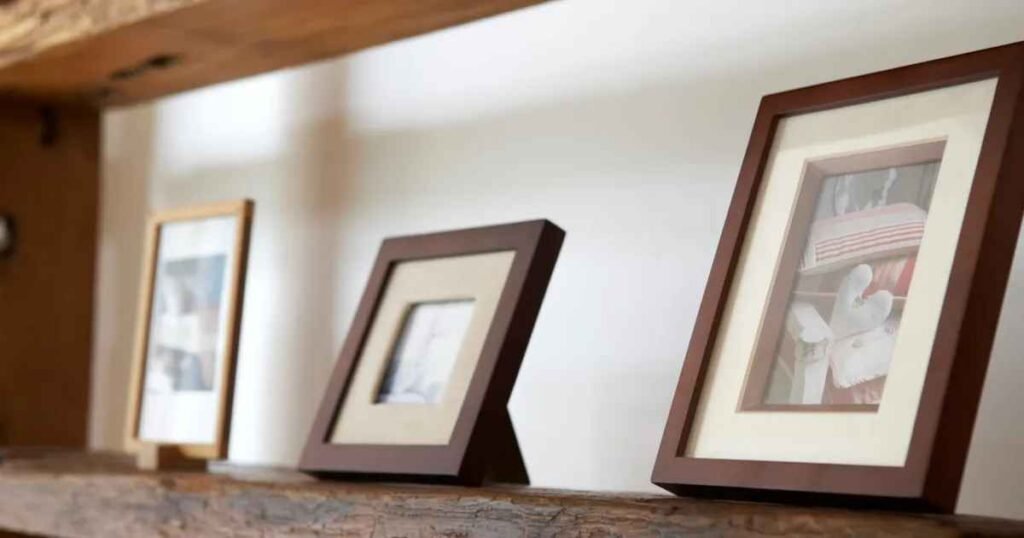
Picture frames follow standard sizes, and 8 inches is a common measurement for the opening.
The most familiar example is the 8 x 10 frame, which holds a photo that is 8 inches on one side and 10 inches on the other.
The opening is the visible window where the photo sits, so the frame looks bigger once you add the border around it.
Stand one on a desk or hang it on a wall and the 8-inch edge is easy to spot.
It is a handy reference because many people already have a frame like this at home.
It shows how 8 inches looks in a flat, rectangular shape.
Practical Tip: Frame sizes describe the photo that fits inside, not the outside of the frame. If the frame comes with a mat, the visible window is smaller than 8 x 10. Always check the opening size and the overall size before you buy, especially if you are planning a gallery wall.
14. Average Male Hand
Open your hand and spread your fingers.
For many adult men, the distance from the wrist to the tip of the middle finger is roughly 7.5 to 8 inches.
That makes your hand the one measuring tool you always carry with you.
Stretch it out flat against a book, a box, or a shelf, and you get a quick idea of the length.
It is not exact, since hand size differs from person to person.
Still, it is fast, free, and works anywhere.
Once you know your own measurement, it becomes a reliable guide.
Practical Tip: Measure your own hand once, from the wrist crease to the tip of your middle finger, and write the number down. If your hand is 7 inches, you know to add one inch. Women’s and children’s hands are often smaller, so do not use someone else’s measurement as your own.
15. A4 Paper (Shorter Side)
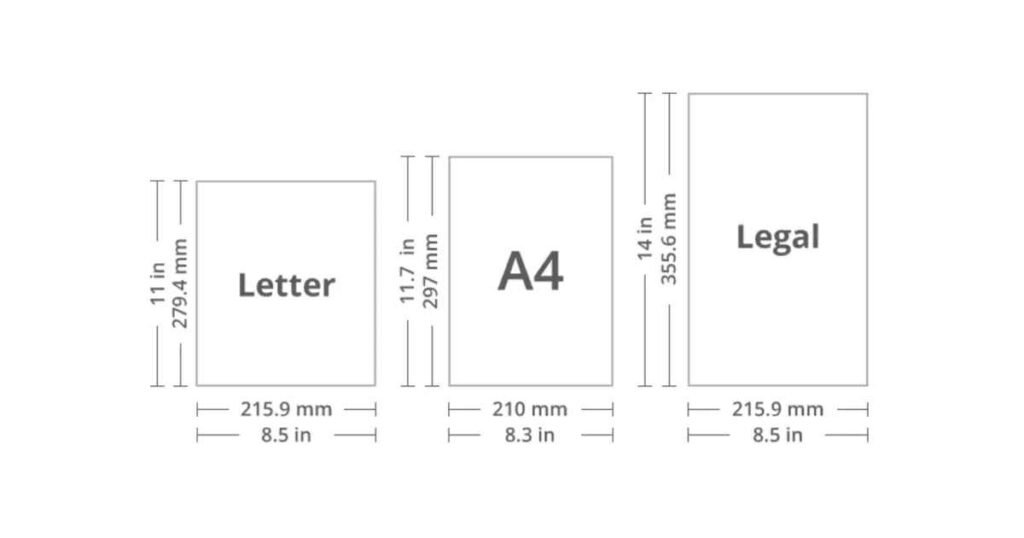
A standard A4 sheet is 210 mm wide and 297 mm long.
Converted, the shorter side is about 8.27 inches, which is a very close match to 8 inches.
It is one of the most common paper sizes in offices, schools, and print shops around the world.
Lay it flat and look at the short edge to see the length straight away.
It runs only about a quarter of an inch over 8 inches.
That small difference makes it one of the easiest references on this list.
Practical Tip: US Letter paper is 8.5 inches wide, which is half an inch more than 8 inches, so do not mix up the two sizes. With A4, fold or mark about 7 mm off the short edge to get a true 8 inches.
How to Measure 8 Inches Without a Ruler
You do not need a ruler to estimate 8 inches.
A few things you already own will do the job.
These methods are meant for quick estimates, so use a ruler when you need exact accuracy.
Use Your Hand and Forearm
Your hand is the easiest measuring tool because you always have it with you.
For many adults, the distance from the wrist to the tip of the middle finger is around 7 to 8 inches.
Measure your own hand against a ruler just once and remember the result.
If your hand measures 7 inches, add about a thumb’s width to reach 8.
Use Paper
Take a sheet of A4 paper and look at the short side.
It measures about 8.27 inches, so it is slightly longer than 8 inches.
Fold in the edge by about a quarter of an inch to get very close to an exact 8 inches.
If you only have US Letter paper, the short side is 8.5 inches, so fold in about half an inch.
Printer paper is easy to find, which makes this one of the most accurate no-ruler methods.
Use Familiar Objects
When you are in the kitchen or at a desk, everyday objects can do the same job.
• Dinner fork: about 7 to 8 inches.
• Medium banana: about 7 to 8 inches.
• Eight US quarters in a row: about 7.6 inches.
• Chef knife blade, 8-inch cake pan, or 8-inch frying pan: 8 inches, as labeled.
Check each object against a ruler once, and after that you can trust it as your own quick guide.
DIY Project: Innovative 8 inches Creations
Knowing what 8 inches looks like can also help with small projects at home.
Here are a few simple ideas that use the objects on this list.
• Embroidery Hoop Wall Art: Stitch a small design in an 8-inch hoop and hang it on the wall just as it is. The hoop works as the frame.
• 8 x 10 Gallery Wall: Use several 8 x 10 frames in a grid for photos or prints. Matching sizes keep the wall neat and balanced.
• Cardboard Measuring Stick: Use an A4 sheet as a guide, mark 20.3 cm on a strip of cardboard, and cut it. You now have your own 8-inch tool for crafts.
• Cake Base Template: Trace the bottom of an 8-inch cake pan on cardboard and cut it out. Use it as a base for cakes you plan to carry or gift.
Always double-check the size with a ruler before you cut, drill, or buy materials.
Here are more size guides you may like:
How Big Is 8 Inches?
Hold an 8-inch object in your fist and it will stick out well past your fingers on one side.
It is clearly longer than your palm, but still easy to handle with one hand.
On a desk, 8 inches looks like a medium length.
It is shorter than a standard 12-inch ruler, but longer than a pen or most smartphones.
8 inches vs 7 inches: the extra inch is about the width of your thumb, but the difference is easy to see.
8 inches vs 9 inches: one more inch makes the object noticeably bigger.
8 inches vs 12 inches: a full foot is 4 inches longer.
8 inches vs 16 inches: 16 inches is exactly double, like placing two 8-inch objects end to end.
Inch to CM Quick Chart
| Inches | Centimeters | Millimeters |
| 5 in | 12.7 cm | 127 mm |
| 6 in | 15.24 cm | 152.4 mm |
| 7 in | 17.78 cm | 177.8 mm |
| 8 in | 20.32 cm | 203.2 mm |
| 9 in | 22.86 cm | 228.6 mm |
| 10 in | 25.4 cm | 254 mm |
| 11 in | 27.94 cm | 279.4 mm |
| 12 in | 30.48 cm | 304.8 mm |
Conclusion
The easiest ways to remember 8 inches are an 8-inch chef knife blade, an 8-inch cake pan, and a sheet of A4 paper turned on its short side.
The first two are made to a fixed size, and the paper is only a quarter of an inch over.
Items such as a banana, a fork, or your own hand are good for quick estimates, but they vary, so check them once against a ruler.
Knowing this length helps when you buy tools, cook, craft, or plan a space.
Keep this guide handy, and you will never have to guess what 8 inches looks like again.

Ryan Carter is the founder of DimensionPulse, creating reliable guides on measurements, dimensions, unit conversions, and size comparisons. He helps readers understand everyday measurements through clear explanations, practical insights, and real-world examples.